
Following competitive Siege teaches you to notice details: a roster change, a map veto, a team struggling on defense. Choosing a sportsbook deserves the same attention. The familiar team names on a betting menu tell you very little about the company holding your money.
For US esports fans who meet their jurisdiction’s legal betting age, the difference between offshore and state-regulated sportsbooks comes down to authorization, oversight, and practical recourse. Before comparing a welcome bonus or match price, find out which rules apply to the account.
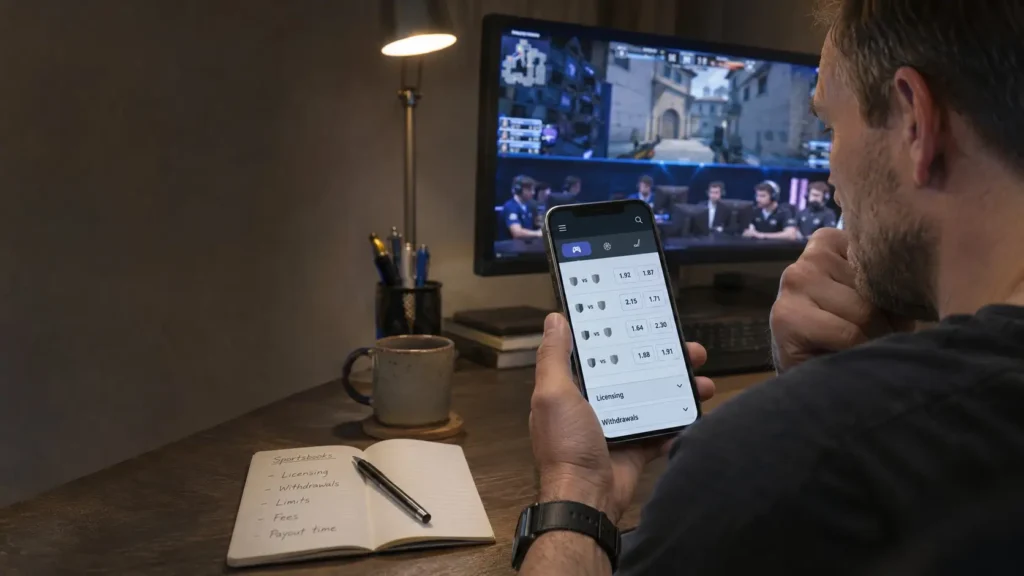
What “offshore” actually means
An offshore sportsbook operates outside the US state licensing system. It may hold a gambling license in another country, but that does not make it licensed to accept wagers in your state.
Michigan’s Gaming Control Board makes the local distinction clear: only operators licensed by the board may legally offer online gaming in Michigan. A foreign license does not replace that approval.
Equally, “regulated” needs context. A site can be regulated overseas without being authorized where you are physically located. Check the operator’s legal name and website against your state regulator’s records rather than relying on a footer logo.
OddsTrader’s offshore versus regulated sportsbook comparison explains how those differences affect access, account protections, and complaints. Use it to frame the comparison, then verify local authorization directly.

A familiar game does not mean a permitted market
An esports betting menu can look reassuringly familiar. You recognize the teams, understand the format, and have watched the tournament all season. None of that establishes whether a particular wager is authorized.
Massachusetts, for example, allows operators to offer only sporting events and wager categories authorized by its Gaming Commission. That illustrates why checking a sportsbook’s license is only the first step: the event and bet type matter too. (Massachusetts wagering standards)
Before considering a wager, confirm that it covers the match, map, or series you intend. Read the rules for overtime, forfeits, substitutions, postponements, and technical interruptions. These are questions worth asking before a disputed result makes them urgent.
Imagine a scheduled best-of-three becomes a best-of-one. Would the original match bet stand? Would map wagers be voided? The answer should come from the sportsbook’s published rules, not assumptions based on how another operator settled something similar.
Price matters, but compare the same bet
Once authorization and eligibility are established, comparing prices can be useful. However, two selections carrying the same team name are not necessarily equivalent.
A series winner differs from a map winner. A handicap covering the full match differs from one covering a single map. Overtime treatment can also change what counts as a winning selection.
Consider a simple illustration: a $20 cash bet at decimal odds of 1.90 returns $38 if it wins, including the stake. At 1.95, the same winning stake returns $39. That extra dollar matters only if you are comparing identical markets and settlement conditions.
Neither price changes the actual likelihood of the team winning. And a slightly better quote says nothing about licensing, withdrawal reliability, or how an account dispute will be handled.
Read the withdrawal rules before depositing
The deposit screen is rarely the difficult part of opening an account. The more revealing questions concern getting money back.
Which withdrawal methods are available? Is there a minimum? Are fees deducted? What documents might be required? Does the advertised timeframe describe internal approval or delivery to your bank?
Offshore sportsbooks can require identity verification too. Cryptocurrency payments do not automatically remove account checks, bonus conditions, or withdrawal restrictions. A fast payment network cannot resolve an operator’s decision to hold a request.
Promotional balances deserve particular attention. For a hypothetical bonus requiring ten times the combined deposit and bonus in wagers, a $100 deposit plus a $100 bonus produces a $2,000 wagering requirement. Eligible bets, deadlines, and withdrawal conditions may narrow the offer further.
OddsTrader’s guide to sportsbook terms and withdrawals provides additional comparisons. Read the current operator terms before accepting any promotion; a bonus is optional, and its headline amount is not spendable cash.
Also check whether the operator clearly explains how to close an account and obtain your transaction history. Those details may seem uninteresting while everything works, but they become useful when you want to stop, review spending, or challenge a transaction you do not recognize later.
Know who hears your complaint
This is where regulatory differences become especially tangible. If customer support cannot explain a settlement or account adjustment, who can review the evidence?
Massachusetts account-management rules provide one concrete example. They allow unresolved payout or refund disputes to be forwarded to the Gaming Commission, with claims submitted in writing and supported by evidence.
That process does not promise a favorable decision. It gives the customer a defined route beyond another support conversation.
For an offshore account, further recourse depends on the operator’s actual licensing arrangements and the relevant jurisdiction. Do not assume your state regulator can resolve that dispute through the same process used for its licensees.
Save the accepted bet slip, applicable rules, transaction references, and support correspondence. A clear record is more useful than trying to reconstruct everything after an account issue appears.
Keep watching separate from wagering
Understanding Siege strategy and understanding betting risk are different skills. Knowing a team’s preferred maps does not make an outcome certain, and watching more matches does not create an obligation to bet.
The same distinction applies to cosmetic trading. Learning about R6 Marketplace order limits can help explain an in-game trading system, but that knowledge should not be treated as preparation for gambling or proof of a betting advantage.
If you choose to wager legally, decide an affordable entertainment budget in advance. Avoid borrowing, chasing losses, or increasing stakes because a match feels unusually predictable. Check the availability of deposit limits, account breaks, and self-exclusion before you need them.
You can follow every round, discuss every roster move, and enjoy a tournament without putting money on it. For anyone choosing otherwise, verifying authorization, reading settlement rules, and understanding withdrawal terms should come before the first deposit.