

https://drive.google.com/file/d/17Ecr12isFQeTMvTcn91cAAVIQrYgjdJM/view?usp=sharing
ALT text: Gaming desk with a prediction bracket and wager sheet beside a keyboard and headset
Image Source: Editorial illustration by author
Picking a team to advance in an esports tournament can mean entering a prediction contest or backing an outcome with a sportsbook wager. The team name may be identical, but the entry means something different. Publisher-run Pick’Ems evaluate predictions under an event’s scoring and reward rules. A sportsbook bet specifies money committed to a defined outcome. Knowing which activity produced a result helps explain what a successful pick, a leaderboard position, or an in-game reward actually represents.
Ubisoft’s guide to the Six Invitational 2026 described predictions about which Rainbow Six Siege teams would advance to the next stage, with in-game rewards for accurate selections. The question concerned progression through the tournament. Choosing a team to advance was therefore different from choosing the eventual champion, even though both predictions could contain the same team name. The event’s question defined what counted as a correct answer.
The wording of the prediction decides which result counts. Advancing to another stage and winning the championship are separate achievements. A correct selection therefore needs its question attached: naming a team alone does not reveal whether the entry concerned a match, a qualifying place, or the title. That distinction remains relevant when the same event also appears in betting discussions.
A wager includes a separate commitment
A sportsbook wager records more than a preferred team. With Lucky Rebel, the selection and stake are specified before the bet is confirmed. For an esports match, the selection identifies the result being backed, while the stake is the money committed to it.
Odds specify how a stake relates to a possible payout. They form part of the wager’s terms and are separate from contest points. Settlement is the decision about a bet’s status under its rules. For a match-winner wager, the relevant match result determines whether the selection was correct; the bettor’s standing against other people making predictions is not part of that decision.
An accepted wager also has a confirmation record. That separates money actually committed from selections merely discussed or entered in a contest. A list of preferred teams contains no equivalent evidence of stakes, accepted terms, or settled bets, however accurately those teams were chosen.
Read the question and the scoring rule
The name “Pick’Em” alone does not explain an event’s conditions. Entry requirements, scoring, and rewards belong to that specific contest. A publisher’s prediction event should be understood through its published rules, rather than assumptions based on another competition with a similar name.
A prediction competition can place entrants on a leaderboard according to its scoring rules. Position on that board compares performance within that competition. It does not, by itself, describe the proportion of all predictions that someone answered correctly. Rank and accuracy are different measurements, even when accurate picks contribute to rank.
Prediction accuracy is calculated by dividing the number of correct predictions by the total number evaluated. A leaderboard position supplies neither count on its own. Even a complete contest record needs the scoring rules alongside it to explain how the final position was reached.
The same distinction prevents a leaderboard result from becoming an estimate of future betting success. It records what happened under a particular set of questions and scoring rules. It does not supply the odds, stakes, or settlement details of future wagers. Nor does it establish that a participant would reproduce that performance across different events.
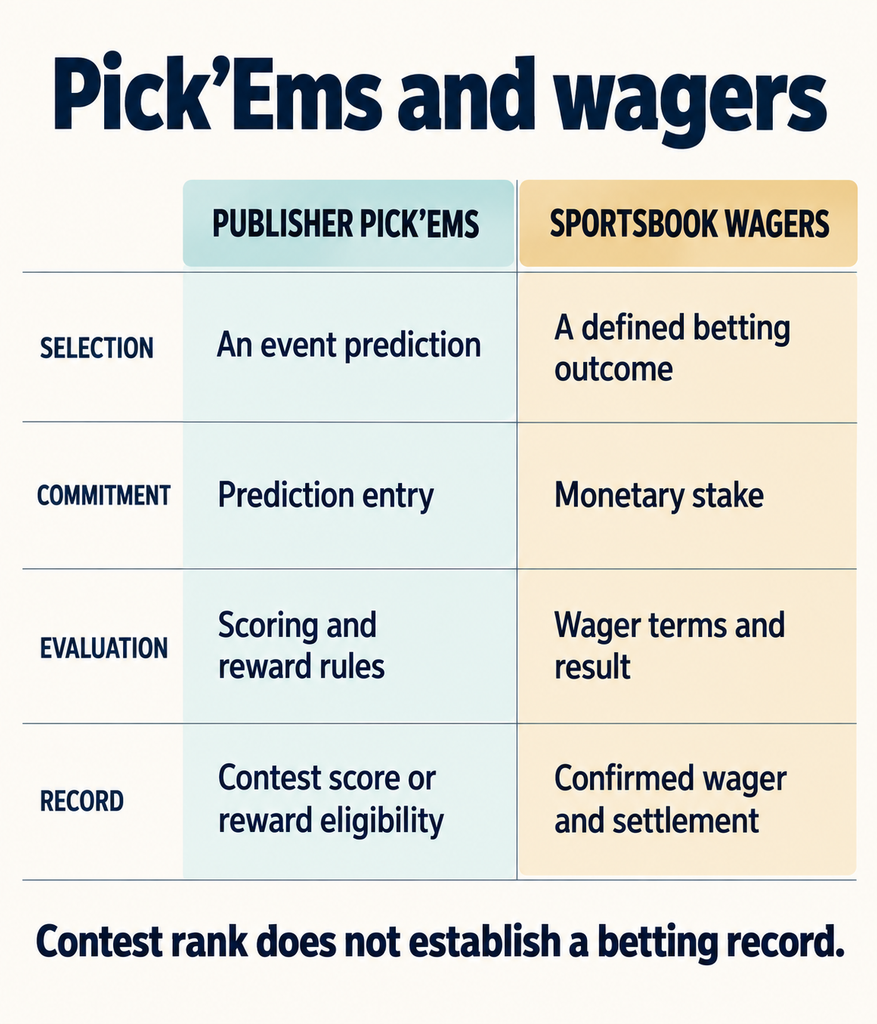
ALT text: Comparison of publisher-run esports prediction contests and sportsbook wagers
Image Source: Infographic by author
Confidence does not specify an amount
Money introduces a decision that simply selecting an answer does not resolve. This bankroll management guide separates an allocation decided in advance from individual betting decisions. It describes setting aside a betting pool for a defined period, such as a season or several months, instead of treating each prediction as a fresh spending decision.
That total allocation and the stake on one wager answer different questions. One concerns the amount set aside over time; the other concerns a single commitment. Confidence in a team does not state either amount. A record of accurate picks therefore cannot explain how much money someone committed, or whether they placed any wagers at all.
What a prediction reward actually shows
Riot’s Champions Paris 2025 Pick’Ems announcement makes the distinction between participation and performance concrete. Its Tejo ¡Eureka! spray required at least one pick in either Groups or Playoffs. It did not require the prediction to be correct. The Golden G.O.A.T. Buddy required a top 20% score. That threshold concerned a participant’s standing against other entrants, rather than the percentage of predictions they answered correctly. A separate title recognized perfect picks.
The announcement listed September 12, 2025, as the group-pick deadline and September 25 as the playoff deadline. The playoff entry window was scheduled to open after the draw and schedule became available. A later-stage prediction could therefore use information unavailable before the tournament, so the date belongs alongside the pick when discussing a prediction record.
A cosmetic item alone is therefore an incomplete account of someone’s predictions. Its qualifying condition supplies the missing context. The same principle applies to a claimed betting record: the selected outcome and wager terms must accompany the result before the record can be understood.