
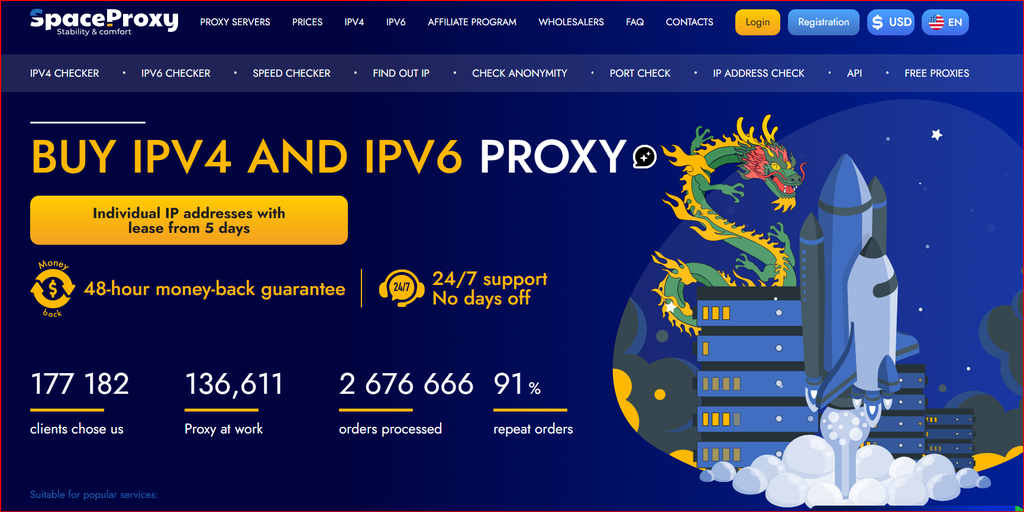
I approached the SpaceProxy proxy platform as fixed infrastructure rather than a promise of unlimited scale. SpaceProxy is easy to notice because the published prices are low and the service advertises a long list of operational controls: individual and shared IPv4, IPv6/32, MTProto, city and subnet selection, API access, auto-renewal and a high published stream allowance. A deep review therefore has to separate useful infrastructure features from numbers that can be misunderstood. I evaluated SpaceProxy as a fixed-proxy platform for legitimate SEO research, regional QA, software testing and repeatable automation, with special attention to where the low-cost model works well and where buyers should slow down and validate the workload first.
Buyer snapshot
| Item | What matters |
|---|---|
| Best fit | Geo testing, SEO collection, fixed-IP automation, software QA and teams that value API-based management |
| Core products | Shared IPv4, individual IPv4, IPv6/32 and MTProto |
| Notable controls | API, city/subnet selection, auto-renewal, manual IP selection and published high concurrency |
| Main buying question | Whether destination limits and shared-IP reputation make the cheapest tier unsuitable for the real workload |
The low-cost model works best when you pilot first
SpaceProxy’s five-day rental option changes the economics of evaluation. Instead of treating proxy procurement as a large upfront purchase, a buyer can run a small proof of concept with the exact country, city and protocol required. That is the right way to use a budget fixed-proxy provider because the meaningful quality metric is not the cheapest price per IP; it is the number of endpoints that successfully complete the intended task with acceptable operational overhead.
I would test individual IPv4 first for any important workflow. Shared IPv4 can then be introduced as a cost-control experiment for lower-risk tasks. This gives the buyer a baseline: if the individual IP works and the shared one does not, reputation or concurrent-use differences become a plausible factor. If neither works, the problem may be the target, the software, the region or the request pattern rather than the plan type.
The 2,000-stream headline is capacity, not a promise of end-to-end speed
SpaceProxy publishes a high stream allowance, which can be valuable for connection-heavy applications. The mistake would be to interpret that number as a guarantee that any destination will happily accept thousands of simultaneous requests. The proxy server is only one part of the path. The website can enforce its own per-IP limits, the local application can exhaust sockets or CPU, DNS can become a bottleneck and the network route can vary by region.
For scaling, I would increase concurrency gradually and measure completed tasks rather than raw open connections. A workload that succeeds at 50 concurrent requests but becomes unstable at 200 should be tuned at the application level before buying more IPs. High published concurrency is useful headroom, but responsible scaling still requires backoff, caching and respect for destination policies.
City and subnet selection are more useful than a giant country count
For regional QA, the ability to choose a city or subnet can be more valuable than simply having dozens of countries. A team validating local landing pages, regional offers or search behavior needs a stable network context. If the IP jumps between unrelated subnets, it becomes harder to interpret changes. Manual selection can therefore improve experiment quality.
I would still verify geolocation independently. Proxy providers and third-party databases can disagree, especially shortly after address allocations change. For a localization test, the internal report should record the proxy, chosen city, geolocation result, browser language, cookies and timestamp. That creates a reproducible test rather than a screenshot with unknown context.
Pricing and value snapshot
The current SpaceProxy pricing makes short pilots practical. The table below is a September 2026 snapshot and should be verified before purchase.
| Plan / quantity | 5 days | 30 days | 90 days | 360 days |
|---|---|---|---|---|
| Shared IPv4, 1-20 IPs | $0.67/IP | $0.99/IP | $2.97/IP | $11.88/IP |
| Individual IPv4, 1-20 IPs | $0.96/IP | $1.77/IP | $5.31/IP | $21.24/IP |
| IPv6/32, 1-99 IPs | $0.10/IP | $0.51/IP | $1.53/IP | $6.12/IP |
| MTProto, 1-20 IPs | $0.96/IP | $1.77/IP | $5.31/IP | $21.24/IP |
API and auto-renewal matter once the workflow is operational
The API is one of the more practical SpaceProxy features for teams. Manual proxy copying is manageable for a handful of endpoints, but it becomes error-prone when a script or internal platform needs to provision, renew, label and replace addresses repeatedly. API-based management makes those operations auditable and repeatable.
Auto-renewal can also reduce accidental endpoint loss when a stable IP is tied to a long-running integration. I would still build renewal alerts on top of it. Infrastructure should not depend on one automatic payment event being successful. A good internal control is to monitor expiration dates and keep a documented replacement process so a failed renewal does not become an outage.
Refund and replacement rules belong in the technical test plan
SpaceProxy publishes refund and exchange information, including conditions around traffic usage and replacement limits. Those rules should be read before a bulk purchase, not after an endpoint fails. A buyer should know what evidence support expects, how quickly a replacement is processed and whether the intended workload could consume enough traffic to affect eligibility.
During a pilot I would deliberately open one support ticket with a real but non-urgent question. That tells you how the support channel works, whether responses are clear and what account details are needed. Support quality is part of proxy quality because endpoint reputation and geolocation problems are normal operational events, not rare exceptions.
Best scenarios for SpaceProxy
SpaceProxy is strongest for fixed-region tasks where low unit cost, stable endpoints and management controls matter: SEO monitoring, localization checks, software integration tests, repeated public-page collection and automation that benefits from an API. Individual IPv4 is the tier I would prioritize when the task has business value; shared IPv4 is a cost-saving option for non-critical checks.
The service is weaker for jobs that specifically demand millions of rotating consumer IPs, mobile carrier identity or automatic per-request rotation. Those are different product categories. Choosing the right architecture first prevents the buyer from judging SpaceProxy against requirements it was not designed to meet.
What I would measure during a 30-day trial
My scorecard would include successful task rate, geolocation accuracy, authentication failures, replacement requests, support turnaround, unexpected captchas, latency distribution and renewal reliability. I would tag each failure as proxy-side, application-side or destination-side. Without that classification, teams often blame the proxy for every error and miss bugs in their own retry logic.
I would also compare cost per successful task between shared and individual IPv4. The shared tier may be cheaper per IP but more expensive per completed job if it triggers more retries. That is the kind of value calculation that a high-quality proxy review should surface.
Pros and limitations
| Pros | Limitations |
|---|---|
| • Low unit pricing and five-day test periods | • Published stream count is not end-to-end performance |
| • API and auto-renewal for repeatable management | • Shared IPv4 can inherit other users’ reputation |
| • City/subnet selection for geo-sensitive QA | • IPv6 compatibility varies by destination |
| • Individual and shared IPv4 plus IPv6/32 and MTProto | • Refund/replacement conditions need to be understood in advance |
| • High published concurrency headroom | • Not a rotating residential/mobile network |
My pre-purchase checklist
- Pilot individual IPv4 on the exact destination first
- Increase concurrency gradually instead of jumping to the published maximum
- Verify city/subnet geolocation independently
- Test the API before integrating it into production automation
- Read replacement and traffic conditions before bulk ordering
- Track cost per successful task, not only cost per IP
How I would run the first week
Day 1 would be a configuration day: buy the smallest sensible batch, label every endpoint, confirm authentication and verify the expected country or city in more than one geolocation database. Days 2 and 3 would run the real workload at deliberately low concurrency so failures are easy to classify. Day 4 would test replacement or support procedures if needed. By days 5 to 7, I would compare completed-task rate, operator time and cost between the candidate tiers before deciding whether a longer rental term is justified.
The key is to preserve evidence. I would keep timestamps, endpoint labels, error classes and destination responses rather than relying on memory. That allows the buyer to distinguish a bad IP from an application bug, an aggressive request pattern or a target-side restriction. A small but disciplined pilot produces more useful information than a large order followed by ad-hoc troubleshooting.
FAQ
Is SpaceProxy good for high concurrency?
It offers high published concurrency headroom, but the usable level still depends on the destination, application and network path.
Should I start with shared IPv4?
For important workflows, I would start with individual IPv4 to reduce concurrent reputation uncertainty.
Why use the API?
It helps teams provision, renew and manage endpoints consistently instead of relying on manual copying.
Is IPv6 the cheapest option?
Yes, but only when the destination and software support IPv6 correctly.
Is SpaceProxy a residential proxy network?
No. It is better evaluated as a fixed-proxy service.
Conclusion
SpaceProxy is most convincing when it is treated as inexpensive fixed infrastructure rather than a shortcut to unlimited scraping or guaranteed performance. The combination of short rentals, API controls, location selection and low pricing gives buyers a practical way to test before scaling. I would choose individual IPv4 for important workflows, use shared addresses selectively, and treat the published stream allowance as capacity headroom rather than a destination guarantee. For current product availability and checkout terms, revisit the SpaceProxy review 2026.
Pricing/specification snapshot reviewed in September 2026. Provider terms can change; verify the current order page before purchase.