
The life of a student-gamer in 2026 is a constant battle of priorities. On one side of your desk, you have a high-refresh-rate monitor screaming for one more match in the latest tactical shooter or an intense session on the R6 marketplace. On the other side, there is a pile of digital textbooks and a looming deadline for a dissertation that feels more like a final boss than a school project. Most people tell you that you have to choose—either be a “try-hard” in school or a “sweat” in the game. But they are wrong.
The secret to mastering both is a concept gamers know well: Min-Maxing. In gaming, you optimize your stats to get the most power out of your character. In real life, you use productivity apps to optimize your time so you can get the best grades while maintaining your rank. By treating your academic career like a high-level strategy game, you can turn the “grind” into a win-win scenario.
Managing a heavy course load while tracking market trends for elite skins or grinding for seasonal rewards can be overwhelming; many students find that using Assignment Help online from a trusted brand like myassignmenthelp allows them the necessary time to focus on their gaming goals without sacrificing their grades. This is essentially the same as hiring a specialized coach or a professional carry in a game. It doesn’t mean you aren’t doing the work; it means you are managing your resources effectively so you don’t crash and burn before the semester ends.
Why Conventional Productivity Fails Gamers
Standard productivity advice is usually written by people who don’t understand why we play. They see gaming as a “waste of time,” whereas we see it as a community, a skill-building arena, and a way to decompress. If an app feels like a lecture, a gamer will delete it within two days. For an app to work for us, it needs to have Feedback Loops, Progress Bars, and Achievable Milestones.
The following table breaks down the different “Classes” of productivity tools and how they help a student-gamer stay ahead of the curve.
Table: The “Loadout” for Academic and Gaming Success
| App Class | Recommended Tool | Best For | Gaming Equivalent |
| RPG Life-Tracker | Habitica | Daily habits & motivation | Character Leveling |
| Information Hub | Notion | Lecture notes & schedules | In-game Wiki / Guide |
| Deep Focus Tool | Forest | Staying off your phone | Concentration/Aim Training |
| System Lockdown | Cold Turkey | Eliminating distractions | Competitive Match Integrity |
| Quick Capture | Todoist | Instant task entry | “Pinging” a Location |
1. Habitica: The Hero’s Journey to a 4.0 GPA
Habitica is perhaps the most famous gamified productivity app, and for good reason. It turns your entire to-do list into an old-school 8-bit RPG. You start by creating an avatar. Every time you complete a task—like finishing a lab report or studying for 30 minutes—you gain Experience Points (XP) and Gold. You can use the gold to buy better gear for your character or “Real Life” rewards, like 30 minutes of gaming time.
However, there is a penalty system. If you miss your “Dailies” (tasks you have to do every day), your character takes damage. If your health hits zero, you lose a level and some of your hard-earned gear. For gamers, this creates a “Loss Aversion” that is much more powerful than a simple reminder notification.
2. Notion: Building Your Personal Academic Wiki
If you’ve ever used a wiki to look up skin prices, operator stats, or map callouts, you already know how Notion works. It is a “modular” workspace. Instead of just having a folder of Word documents, Notion allows you to build a structured database of your entire life.
In Notion, you can create a “Master Syllabus” that automatically counts down the days until your next big project. You can embed videos, link your research papers, and even track your gaming budget in the same place. The goal is to reduce “Context Switching.” When everything is in one app, your brain doesn’t have to work as hard to shift from “Student Mode” to “Gamer Mode.”
3. Forest: The Ultimate Anti-Distraction “Mini-Game”
One of the hardest things for a gamer is the “Just One More” mentality. You think you’ll just check a Discord notification, and an hour later, you’re looking at memes instead of your psychology textbook. Forest stops this by turning your focus into a living thing.
When you start a study session, you plant a digital tree. If you leave the app to check your phone, the tree withers and dies. If you stay focused for the full 25 or 50 minutes, the tree is added to your permanent forest. Over a month, you can see a visual representation of all the hours you spent working.
For those in STEM or IT degrees, the technical workload can be especially brutal. If you find yourself stuck on a logic error for hours, seeking programming assignment help from experts can get you past the hurdle; once the path is clear, you can fire up Forest and get the rest of the code written in a focused “sprint.” This ensures you don’t spend all night staring at a broken script when you could have been gaming.
4. Cold Turkey: Going “Hardcore Mode” on Distractions
There are times when your self-control simply fails. Maybe a new season just dropped, or there’s a limited-time event on the marketplace, and you know you won’t be able to resist launching the game. This is where Cold Turkey comes in. It is the “Final Boss” of productivity apps.
Cold Turkey doesn’t just ask you nicely to stop; it locks you out. You can set it to block specific game launchers (like Ubisoft Connect, Steam, or Epic) during school hours. Once you start a “Lock,” it is incredibly difficult to bypass. You can’t just kill it in the Task Manager or restart your computer to get around it. It forces you to deal with your responsibilities.
5. Todoist: Clearing Your Mental “RAM”
In gaming, “Mental Stack” refers to the number of things you are trying to keep track of at once. If you’re trying to remember where an enemy is, what your cooldowns are, and how much time is left in the round, you’re going to perform worse. The same happens in school. If you are trying to remember three different assignment dates while you’re gaming, you won’t play at your best.
Todoist is a “Quick Capture” tool. Its job is to take the thought out of your head and put it into a secure system immediately. It has a feature called “Natural Language Input.” You can just type “Math assignment due next Tuesday at 5pm,” and it will automatically set the reminder and category. This allows you to “dump” your school worries so you can have 100% focus during your matches.
The Synergy Between Gaming and Productivity
A lot of people think gaming and productivity are opposites, but they actually use the same skills. Both require resource management, spatial awareness, strategic planning, and quick decision-making. The problem is that school often feels slow and unrewarding compared to a high-octane game.
By using the apps listed above, you are essentially “modding” your life to make school feel more like a game. When you see a progress bar for your essay moving from 0% to 100%, it provides the same hit of dopamine as watching a rank-up animation.
How to Build Your “Daily Quest” Routine
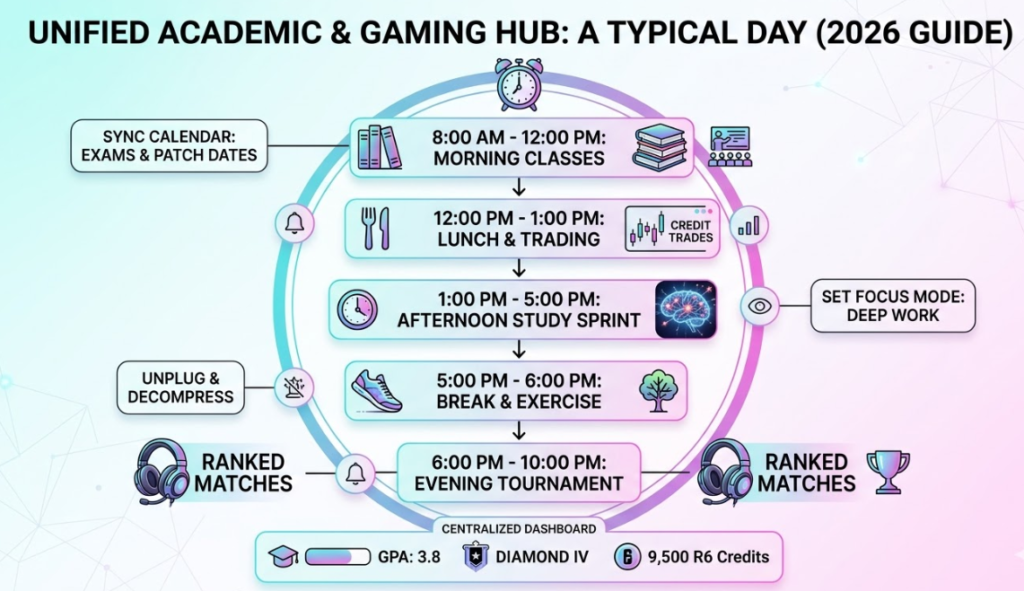
To truly rank on the first page of life, you need a routine. Here is a sample “Daily Quest” layout for a student-gamer:
- Morning (The Daily Login): Open Todoist and see what “Quests” (assignments) are due today.
- Afternoon (The Grind): Use Notion to take notes during lectures and Forest to stay focused during study breaks.
- Late Afternoon (The Boss Fight): If an assignment is too complex or time-consuming, don’t be afraid to use myassignmenthelp to get the support you need.
- Evening (The Reward): Once your tasks are checked off in Habitica, your gaming time is your reward. No guilt, no stress, just pure gameplay.
Conclusion: Excellence in All Arenas
Being a gamer doesn’t have to be a handicap to your education. In fact, the discipline it takes to reach the top 1% of a competitive ladder is the exact same discipline it takes to get an A in a difficult university course. The only difference is the tools you use.
By leveraging apps like Habitica, Notion, and Forest, and knowing when to seek professional help for your writing or programming tasks, you become a versatile “Multi-Class” individual. You aren’t just a student, and you aren’t just a gamer. You are someone who knows how to use every tool at their disposal to win.
Frequently Asked Questions
How can virtual rewards actually help with real-world deadlines?
Digital tools use game-like mechanics such as experience points and leveling systems to trigger the brain’s reward centers. By turning academic milestones into “quests,” students feel a tangible sense of progress that makes repetitive tasks like studying feel less like a chore and more like achieving a new high score.
Will these tools interfere with my actual gaming performance?
Actually, they do the opposite. By organizing your schedule and clearing your mental workload, you reduce the stress and “tilt” that often come from playing with unfinished responsibilities. A clear mind leads to better focus, faster reaction times, and more consistent gameplay during competitive matches.
Can using a website blocker really improve long-term discipline?
Yes, because it helps build “deep work” habits. Hardcore blockers act as a digital safety net, preventing reflexive distractions during critical study windows. Over time, your brain becomes accustomed to staying focused for set periods, which naturally strengthens your self-control both in the classroom and in-game.
Is it possible to track both group projects and individual study sessions?
Most modern productivity platforms allow you to create separate “databases” or workspaces for different needs. You can set up a collaborative board for university team projects while maintaining a private, gamified dashboard for your personal study goals and hobby tracking, all within a single interface.
About The Author
Ella Thompson is a professional educational consultant at myassignmenthelp with over a decade of experience in academic planning. Specializing in strategic guidance for international students, she focuses on helping learners balance rigorous study schedules with personal development.