
ProxyStores Buyer’s Review 2026: Which Proxy Tier Should You Actually Choose?
This ProxyStores proxy service review starts with a buyer question rather than a feature list. ProxyStores offers several fixed-proxy products at prices low enough that a buyer can easily choose based on cost alone. That would be a mistake. Shared IPv4, individual IPv4, IPv6/32 and MTProto are not four versions of the same product; they solve different operational problems. My 2026 buyer’s review focuses on that decision. I looked at the catalog, pricing, protocol options, location controls and the kinds of failure modes each tier introduces, then built a practical selection framework for buyers who want predictable infrastructure rather than the cheapest number on a pricing page.
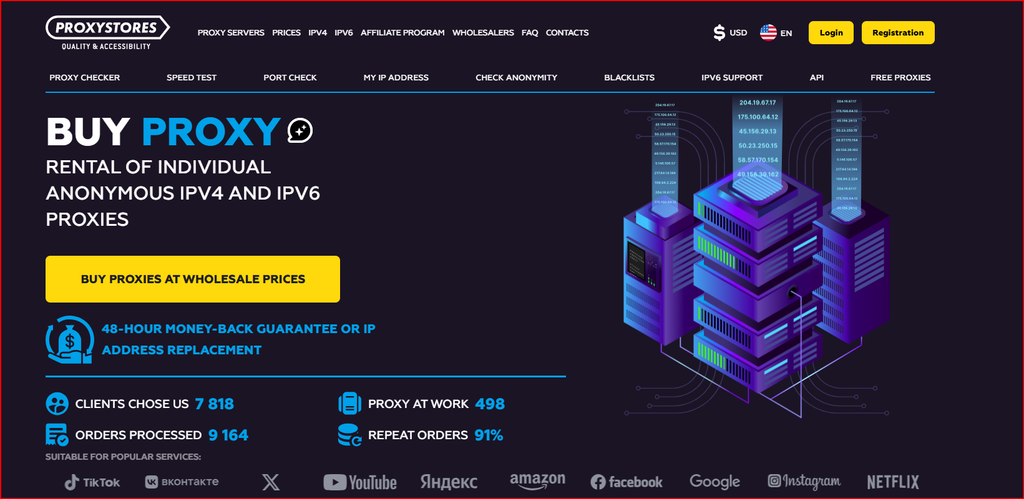
Buyer snapshot
| Item | What matters |
|---|---|
| Best fit | Regional QA, fixed-IP research, software testing, private browser profiles and Telegram-oriented MTProto use |
| Core products | Shared IPv4, individual IPv4, IPv6/32 and MTProto |
| Useful controls | HTTP/SOCKS5, location selection, IP binding and account management |
| Main buying question | Which tier minimizes total operational cost for the actual destination |
Start with the task, not the plan name
The simplest way to choose a ProxyStores tier is to describe the task in operational terms. Does the application need a stable IPv4 address? Can it use IPv6? Will a user log in repeatedly from the same endpoint? Is the proxy only for public-page checks? Is Telegram the specific target? Once those questions are answered, most of the catalog becomes easier to understand.
For example, a private browser profile used by one operator benefits from individual IPv4 because concurrent sharing creates unnecessary uncertainty. A disposable public-page check may be fine on shared IPv4. A cost-sensitive internal API test could use IPv6 if the destination supports it. MTProto belongs in a Telegram-specific decision, not a generic browser comparison.
Individual IPv4 is the safest default for business-critical fixed sessions
When a workflow has business value, I prefer individual IPv4 because it gives the buyer control over concurrent use from the moment the address is assigned. This does not guarantee perfect historical reputation, but it removes one major variable: another customer using the same IP at the same time. That improves troubleshooting and makes session behavior more predictable.
The price premium over shared IPv4 is small in absolute terms for a limited number of addresses. If one failed session, blocked integration or manual troubleshooting hour costs more than the price difference, individual IPv4 is the rational choice. Buyers should compare operational risk, not only per-IP price.
Shared IPv4 is useful when the workload can tolerate uncertainty
Shared IPv4 is appropriate for low-risk tasks where a blocked or noisy endpoint does not create significant business impact. It can be useful for public research, non-authenticated regional checks or secondary monitoring. The key is to avoid attaching critical identity or long-lived sessions to a shared address without a reason.
I would also monitor shared endpoints more aggressively. If captcha frequency, timeouts or reputation-related errors increase, rotate the affected IP or move the task to individual IPv4. Cheap infrastructure remains useful only while the operational overhead stays low.
Pricing and value snapshot
The current ProxyStores pricing makes short pilots practical. The table below is a September 2026 snapshot and should be verified before purchase.
| Plan / quantity | 5 days | 30 days | 90 days | 360 days |
|---|---|---|---|---|
| Shared IPv4, 1-20 IPs | $0.67/IP | $0.99/IP | $2.97/IP | $11.88/IP |
| Individual IPv4, 1-20 IPs | $0.96/IP | $1.77/IP | $5.31/IP | $21.24/IP |
| IPv6/32, 1-99 IPs | $0.10/IP | $0.51/IP | $1.53/IP | $6.12/IP |
| MTProto, 1-20 IPs | $0.96/IP | $1.77/IP | $5.31/IP | $21.24/IP |
IPv6 should be chosen for compatibility, not because it is cheap
IPv6/32 is the lowest-cost product in the catalog, but it is only a bargain when the destination and application support IPv6 correctly. Many modern services do, but not all. Some third-party libraries, older software and access-control systems still assume IPv4. A buyer who skips compatibility testing can save on the proxy and lose far more time debugging the stack.
I would run a small connectivity matrix before scaling: test DNS resolution, destination reachability, authentication, application support and geolocation. If all five pass, IPv6 can be an excellent cost-control option. If one fails, move to IPv4 rather than forcing the wrong network layer into production.
MTProto is a specialized product, not a general privacy upgrade
MTProto is relevant for Telegram-oriented connectivity. It should not be compared with ordinary HTTP or SOCKS5 proxies as though it were simply a faster or more secure version. The protocol exists for a different application context.
A buyer using Telegram should still respect platform rules and local law. From an infrastructure perspective, the advantage of having MTProto in the same account is procurement simplicity: teams that also need fixed IPv4 or IPv6 do not have to manage an entirely separate vendor for one protocol.
The five-day rental period is the right way to buy
ProxyStores’ short rental window makes it possible to evaluate the exact region and product type before committing to 90 or 360 days. I would use that option aggressively. The pilot should include normal workload traffic, not a synthetic ping test. The relevant question is whether the endpoint works inside the actual application and destination.
During the pilot, log geolocation accuracy, success rate, captcha frequency, support requests, authentication issues and replacement needs. At the end, calculate cost per successful task. That metric can show that the more expensive private tier is actually cheaper than shared IPv4 once retries and operator time are included.
How I would choose between the four tiers
My decision order is straightforward. Choose individual IPv4 when stable sessions and clear ownership matter. Choose shared IPv4 when the task is cheap, disposable and tolerant of reputation noise. Choose IPv6 when compatibility has been proven and price matters. Choose MTProto only for the Telegram-specific use case. That framework prevents buyers from overpaying for features they do not need or underpaying for a tier that creates more troubleshooting than it saves.
If the project instead requires rotating residential identities, carrier mobile IPs or a huge global consumer pool, I would not try to make these fixed tiers imitate a different architecture. The correct decision may be to use another product category entirely.
Pros and limitations
| Pros | Limitations |
|---|---|
| • Clear product separation by use case | • Shared reputation can create inconsistent results |
| • Low short-term pricing for proof-of-concept testing | • IPv6 is not universally supported |
| • HTTP/SOCKS5 support for common applications | • MTProto is narrow-purpose rather than general-purpose |
| • IPv6 and MTProto options in the same catalog | • Not designed as a rotating residential/mobile network |
| • Useful for stable fixed-IP workflows | • Buyers still need to validate geolocation and destination compatibility |
My pre-purchase checklist
- Describe the task before choosing the tier
- Prefer individual IPv4 for critical sessions
- Use shared IPv4 only where reputation noise is acceptable
- Prove IPv6 compatibility before buying volume
- Use MTProto only for its intended Telegram context
- Calculate cost per successful task after the pilot
How I would run the first week
Day 1 would be a configuration day: buy the smallest sensible batch, label every endpoint, confirm authentication and verify the expected country or city in more than one geolocation database. Days 2 and 3 would run the real workload at deliberately low concurrency so failures are easy to classify. Day 4 would test replacement or support procedures if needed. By days 5 to 7, I would compare completed-task rate, operator time and cost between the candidate tiers before deciding whether a longer rental term is justified.
The key is to preserve evidence. I would keep timestamps, endpoint labels, error classes and destination responses rather than relying on memory. That allows the buyer to distinguish a bad IP from an application bug, an aggressive request pattern or a target-side restriction. A small but disciplined pilot produces more useful information than a large order followed by ad-hoc troubleshooting.
FAQ
Which ProxyStores tier would I choose first?
For a business-critical fixed session, individual IPv4 is the safest default.
When does shared IPv4 make sense?
For low-risk, disposable or public-page tasks where reputation variability is acceptable.
Is IPv6 always cheaper?
Yes in unit price, but it is only useful if the complete workflow supports it.
Should MTProto be used for browser traffic?
No. It is a Telegram-specific product, not a general browser proxy.
Can ProxyStores replace a residential proxy network?
Not when the requirement is rotating consumer or mobile identity. That is a different architecture.
Conclusion
ProxyStores is easy to understand once the buyer stops comparing every tier only by price. Individual IPv4 is the strongest all-purpose choice for stable business workflows, shared IPv4 is a budget option for tolerant tasks, IPv6 is a compatibility-driven cost optimization and MTProto serves a specialized Telegram use case. The short rental terms make it practical to test each decision before scaling, which is exactly how I would buy from this catalog. For current product availability and checkout terms, revisit the ProxyStores review 2026.
Pricing/specification snapshot reviewed in September 2026. Provider terms can change; verify the current order page before purchase.This ProxyStores proxy service review starts with a buyer question rather than a feature list. ProxyStores offers several fixed-proxy products at prices low enough that a buyer can easily choose based on cost alone. That would be a mistake. Shared IPv4, individual IPv4, IPv6/32 and MTProto are not four versions of the same product; they solve different operational problems. My 2026 buyer’s review focuses on that decision. I looked at the catalog, pricing, protocol options, location controls and the kinds of failure modes each tier introduces, then built a practical selection framework for buyers who want predictable infrastructure rather than the cheapest number on a pricing page.