
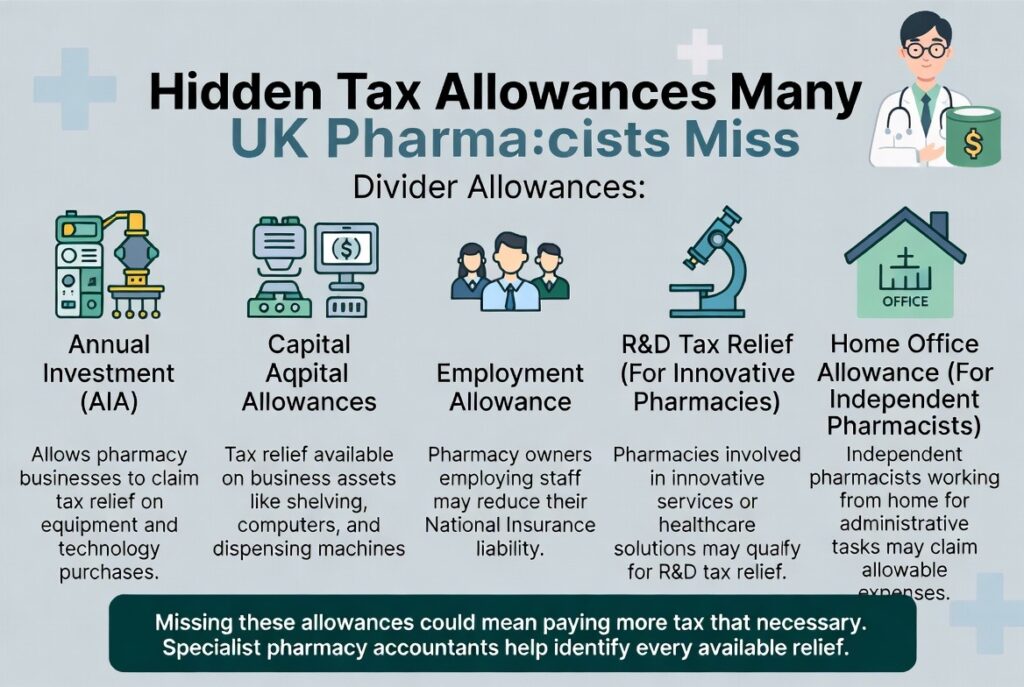
In the world of pharmacy, precision is everything. A minor oversight in a prescription can have significant consequences. Yet, when it comes to their own financial health, many of the UK’s most hardworking pharmacists are surprisingly prone to oversights.
The reality is that many pharmacists, whether you are a community pharmacist, a hospital clinician, or a frequent locum are effectively taking a “hidden pay cut” every year. How? By overpaying tax. The UK tax system is notoriously labyrinthine, and for medical professionals who juggle multiple income streams, the complexity scales exponentially.
Common pain points we see daily include:
- Missing legitimate tax deductions because they didn’t know a certain fee was “allowable.”
- Misunderstanding travel rules, leading to thousands in missed mileage claims.
- Receiving “surprise” HMRC bills because they weren’t prepared for Payments on Account.
- Falling into the “60% tax trap” as their income crosses the £100,000 threshold.
Whether you are a locum pharmacist working across ten different pharmacies or a business owner managing a limited company, specialized accounting for pharmacists is the difference between struggling with HMRC and having a streamlined, tax-efficient career. In this guide, we will break down every relief, allowance, and strategy you need to keep more of your hard-earned money.
2. Understanding How Pharmacists Are Taxed in the UK
Before diving into reliefs, we must establish how you are being taxed. Most pharmacists fall into one of three categories, and often, they move between all three in a single year.
Employed Pharmacists (PAYE)
If you work for a large multiple (like Boots or Superdrug) or the NHS, your tax is usually deducted at source via Pay As You Earn (PAYE). While this is “easier,” it often leads to a false sense of security where pharmacists assume they cannot claim expenses. This is incorrect. You can still claim professional fees and certain training costs.
Locum Pharmacists (Self-Employed / Sole Trader)
Most locums operate as sole traders. You are responsible for your own National Insurance and Income Tax via the Self-Assessment system. This offers the most flexibility for claiming pharmacist tax relief in the UK, but it requires meticulous record-keeping.
Pharmacists Operating Through Limited Companies
For high-earning locums or those owning their own pharmacy, a limited company structure can be more tax-efficient. You pay Corporation Tax on profits and extract money via a combination of salary and dividends.
Income Tax Bands & National Insurance
For the current tax year, remember the core bands:
- Personal Allowance: Up to £12,570 (0%)
- Basic Rate: £12,571 to £50,270 (20%)
- Higher Rate: £50,271 to £125,140 (40%)
- Additional Rate: Over £125,140 (45%)
Do locum pharmacists need to file self-assessment? Absolutely. If you earn more than £1,000 from self-employment, you must register and file a return by January 31st each year.
3. The Most Common Tax Reliefs Available to UK Pharmacists
The term “allowable expenses” simply refers to costs that are “wholly and exclusively” for the purpose of your trade. If you pay for these out of your own pocket, you can deduct them from your taxable income.
Professional Expenses
These are the “low-hanging fruit” of tax deductions for pharmacists.
- GPhC Registration Fees: This is your license to practice. HMRC allows full tax relief on this.
- Professional Memberships: Fees for the Royal Pharmaceutical Society (RPS) and the Pharmacists’ Defence Association (PDA) are generally deductible.
- Indemnity Insurance: Crucial for locums; this is a 100% allowable expense.
Continuing Professional Development (CPD)
You are required to stay clinically up-to-date. If you pay for:
- Clinical training programs or specialized courses.
- Attendance at pharmacy conferences.
Professional journals and reference books (like a personal copy of the BNF).
- These are all deductible, provided they reinforce your existing knowledge rather than qualifying you for a completely new career.
Equipment and Tools
Do you use a laptop for clinical research or admin? A tablet for checking the Drug Tariff? If these are used for your work, a proportion of the cost (or the full cost via capital allowances) can be claimed.
4. Allowable Expenses Many Pharmacists Forget to Claim
This is where standard accountants often fail their clients. Specialized accounting for pharmacists looks deeper into your daily routine.
Travel and Mileage
This is the most misunderstood area of locum pharmacist tax in the UK.
- The Rule: You cannot claim to travel to a “permanent workplace.”
- The Opportunity: Most locums work at “temporary workplaces” (different pharmacies). If you travel from home to a pharmacy you only visit occasionally, the mileage is claimable at 45p per mile for the first 10,000 miles and 25p thereafter.
- Pro Tip: This includes public transport, tolls, and parking fees.
Home Office Expenses
If you spend your Sundays doing invoices, CPD entries, or research from home, you are entitled to claim a portion of your household bills (internet, lighting, heating). HMRC offers a “simplified expenses” flat rate, or we can calculate the actual proportion of your bills for a higher deduction.
Accounting and Professional Services
The fees you pay for professional accounting for pharmacists are themselves tax-deductible. Essentially, HMRC helps subsidize the cost of ensuring your taxes are handled correctly.
5. Capital Allowances Pharmacists Can Claim
While “expenses” usually refer to day-to-day costs, “Capital Allowances” refer to larger assets.
Annual Investment Allowance (AIA)
The AIA allows you to claim 100% tax relief on the purchase of equipment in the year you buy it.
- Technology: Computers, printers, and tablets.
- Medical Equipment: If you perform vaccinations and buy your own specialized fridge or clinical furniture for a private consultation room.
- Office Furniture: Desks and chairs for your home office.
Can pharmacists claim laptops on tax? Yes, as long as it is used for business purposes. If there is personal use, we simply “apportion” the claim (e.g., if it’s used 70% for work, we claim 70% of the cost).
6. The Hidden Tax Traps Many Pharmacists Face
Payment on Account
If your self-employed tax bill is over £1,000, HMRC assumes you will earn the same next year. They ask for half of next year’s tax in January and the other half in July. This often results in a “surprise” bill that is 150% of what the pharmacist expected.
The 60% Tax Trap
Once your “Adjusted Net Income” hits £100,000, you lose £1 of your Personal Allowance for every £2 you earn above that limit. This creates a “dead zone” where your effective tax rate is 60%.
The math works like this:
40% (Higher Rate Tax)+20% (Loss of Allowance)=60%
For many pharmacists, earning £110,000 results in less take-home pay than earning £99,000 after tax and student loans are considered.
7. How Much Tax Pharmacists Actually Pay (Examples)
Let’s look at three realistic scenarios for a locum pharmacist.
| Scenario | Gross Income | Est. Tax & NI (No Claims) | Est. Tax & NI (With Specialist Claims) | Potential Saving |
| 1. The Part-Time Locum | £50,000 | £11,400 | £10,200 | £1,200 |
| 2. The Full-Time Locum | £80,000 | £23,500 | £21,000 | £2,500 |
| 3. The High-Earner | £120,000 | £42,000 | £36,500 | £5,500 |
Note: These figures are estimates. Actual savings depend on mileage, pension contributions, and professional fees.
8. Sole Trader vs. Limited Company for Pharmacists
This is the most common question in accounting for pharmacists.
| Factor | Sole Trader | Limited Company |
| Setup Complexity | Very Low | Moderate |
| Tax Flexibility | Limited (Pay tax on all profit) | High (Control salary/dividends) |
| Admin Burden | One Tax Return | Annual Accounts, Corp Tax, Payroll |
| IR35 Risk | Low | High (for locums) |
When should you switch? Historically, the “tipping point” was around £50,000. However, with recent changes to Corporation Tax and Dividend Allowances, the decision is now more complex. We typically recommend a Limited Company for pharmacists earning consistently over £70,000 or those looking to grow a pharmacy business with multiple staff.
9. Tax Planning Strategies to Reduce Your Tax Bill
Pension Contributions
Making a contribution into a SIPP (Self-Invested Personal Pension) or an NHS pension not only secures your future but also reduces your “Adjusted Net Income.” This is the primary way to escape the 60% tax trap mentioned earlier.
Expense Timing
If you know you need a new laptop or a big training course, buying it on April 4th (just before the tax year ends) can reduce your tax bill for the current year, rather than waiting until May.
Income Structuring
If you have a limited company, we can help you split income with a spouse (if they perform legitimate work for the business) or time your dividend payments to stay within the basic rate band.
10. Record Keeping and HMRC Compliance
HMRC requires you to keep records for at least 5 years after the January 31st deadline. If you are ever audited, you will need:
- Invoices/Remittances: From the pharmacies or agencies you work for.
- Receipts: Digital or paper copies for every expense claimed.
- Mileage Logs: A simple spreadsheet or app (like MileIQ) showing dates, locations, and purpose of travel.
- Bank Statements: Ideally, keep a separate “business” bank account to avoid mixing personal and professional spending.
11. Common Tax Mistakes Pharmacists Make
- Failing to register for Self-Assessment: Thinking HMRC “already knows” because of PAYE work.
- Not saving for tax: We recommend setting aside 25-30% of every locum invoice in a separate savings account.
- Missing “Backdated” Claims: You can often claim for professional fees missed in the previous 4 years.
- Ignoring HMRC Letters: HMRC issues penalties automatically for late filings. Even if you owe no tax, the fine for a late return is £100 instantly.
12. When Pharmacists Should Work with an Accountant
If you are a student or a newly qualified pharmacist with a single PAYE job, you can likely manage your own affairs. However, you should seek professional support if you:
- Are earning above £70,000 total income.
- Work as a locum across multiple sites.
- Have both PAYE and self-employed income (a nightmare for tax coding).
- Are considering forming a Limited Company.
At Lanop Business & Tax Advisors, we don’t just “do your taxes.” We provide a specialized service in accounting for pharmacists. We understand the difference between Category M and the Drug Tariff, and we know exactly how to protect your clinical income from unnecessary taxation.
How Lanop Business & Tax Advisors Supports Pharmacists with Tax Relief
Understanding and claiming the right tax reliefs can be challenging for many pharmacists, especially those working as locums or managing multiple income streams. This is where Lanop Business & Tax Advisors provides specialist support.
Lanop offers tailored accounting for pharmacist services that help identify all eligible deductions such as professional memberships, CPD courses, travel between pharmacies, and work-related equipment. Their team also assists with self-assessment tax returns, HMRC compliance, and strategic tax planning, ensuring pharmacists do not overpay tax.
With expert guidance, pharmacists can maximise available tax reliefs, stay compliant with HMRC regulations, and manage their finances more efficiently.
Frequently Asked Questions
1. What professional expenses can UK pharmacists claim?
You can deduct GPhC registration fees, professional indemnity insurance, CPD and training costs, RPS membership, and relevant journal subscriptions whether you’re employed or self-employed.
2. What capital allowances are available to pharmacy owners?
You can claim the Annual Investment Allowance (up to £1 million) on dispensing robots, PMR systems, and shop fit-outs. Limited companies also benefit from Full Expensing, allowing 100% deduction on qualifying plant and machinery in the year of purchase.
3. Are there tax advantages for locum pharmacists using a limited company?
Yes. You can take a salary and dividend combination to reduce National Insurance, claim employer pension contributions as a business expense, and deduct travel, equipment, and home office costs provided your contracts fall outside IR35.
4. How does pension tax relief work for pharmacists?
Personal contributions receive automatic basic rate relief, and higher-rate taxpayers can claim additional relief through Self Assessment. The annual allowance is £60,000 (2024/25), with unused allowance from the previous three years available to carry forward.
5. What travel expenses can pharmacists claim?
Locums can claim travel from home to each pharmacy at 45p per mile (first 10,000 miles). Employed pharmacists can claim travel between work locations during the day but not standard commuting costs.
14. Pharmacist Tax Relief Checklist
Ensure you are claiming every penny you deserve:
- GPhC Registration Fees (Annual renewal)
- RPS / PDA / BPSA Memberships
- Professional Indemnity Insurance
- Clinical Training & CPD Courses
- Travel & Mileage (Between pharmacies/sites)
- Equipment (Laptops, tablets, clinical tools)
- Home Office Allowance (Broadband, heating, lighting)
- Accounting Fees (Yes, even our bill is deductible!)
Conclusion
As a pharmacist, you play a vital role in supporting the UK healthcare system. It’s only fair that you benefit from the tax reliefs and allowances available to professionals in your field. Understanding allowable expenses and tax-saving opportunities is the first step toward managing your finances more efficiently and ensuring you are not paying more tax than necessary.
By partnering with Lanop Business & Tax Advisors, specialists in accounting for pharmacists, you can ensure that every legitimate tax relief is claimed and your finances are managed in a tax-efficient way.
Don’t leave money on the table. If you’d like expert support, the team at Lanop Business & Tax Advisors can review your recent tax returns and help identify any missed professional expenses or tax-saving opportunities you may be entitled to claim.